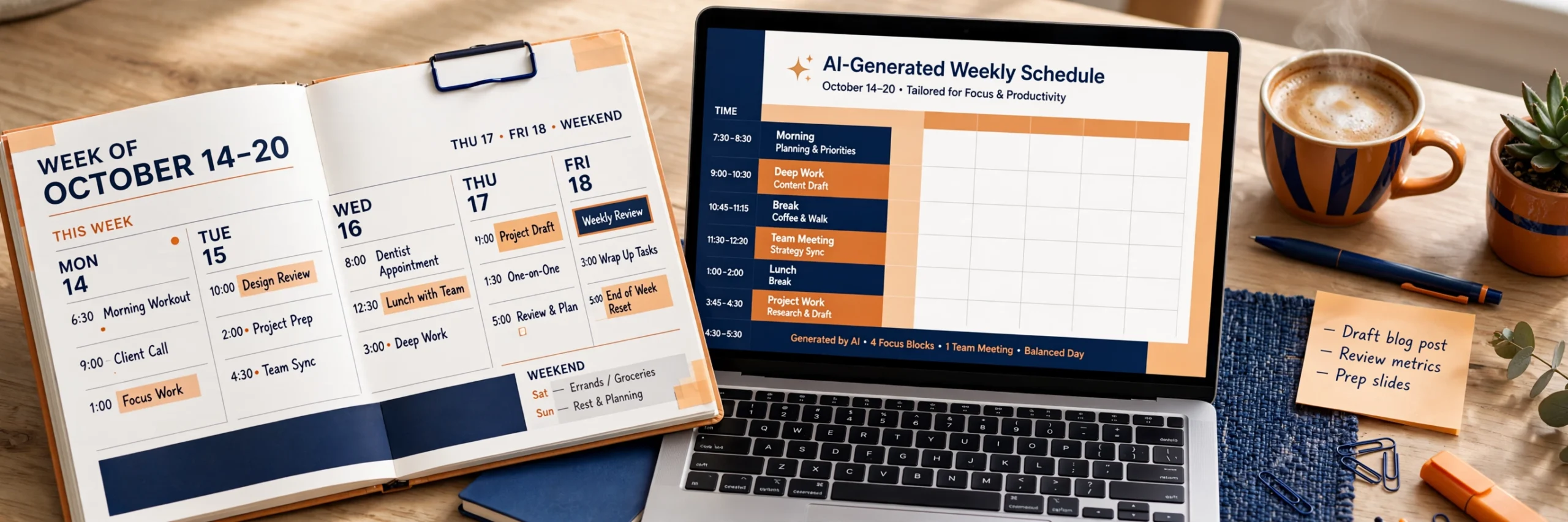
My old "weekly planning" was opening my laptop on Monday, staring at 47 open tabs and a to-do list from last Tuesday, and then doing email for three hours. Sound familiar?
Here's the 20-minute routine I actually stick with. Do it Sunday evening or Monday morning — coffee optional but recommended.
Key takeaways:
- Brain-dump everything first — AI can't plan what it can't see.
- Tell it your real constraints (kids, meetings, energy dips) or the plan will be fantasy.
- When the week blows up, re-plan in 5 minutes instead of abandoning the plan.
Step 1: The Brain Dump (5 minutes)
Open ChatGPT, Claude, or Gemini and paste this:
"Here is everything on my plate this week: [paste every task, appointment, deadline, and nagging worry — messy is fine]. Ask me up to 5 clarifying questions about anything unclear, then wait for my answers."
That last sentence matters. Most people ask AI to plan from a half-formed list and get a half-formed plan. Let it interrogate you first — it usually asks about deadlines, how long things take, and what your week actually looks like. Answer honestly.
Step 2: Set Your Constraints (3 minutes)
Now give it the reality check most planning advice skips:
"Here are my constraints: I work [hours], I have [meetings/kids/pickup/etc.], my energy crashes around [time], and I refuse to work on [day/evening]. Given my task list, build me a day-by-day plan. Put deep work in my high-energy hours, batch small admin tasks together, and leave one buffer slot per day for surprises."
The buffer slot is the secret. Plans without slack die on Tuesday. A plan with daily 30-minute buffers bends instead of breaking.
Step 3: The Sanity Check (5 minutes)
"Now be brutally honest: is this plan realistic? Point out where I'm overcommitting, which day is overloaded, and what you'd cut or move. Suggest the 3 tasks I should do first if the week goes sideways."
I do this every week and AI calls me out every week. Last month it told me I'd scheduled 11 hours of work into a 6-hour Wednesday. It was right. Cut the Wednesday tasks now, while it's painless, instead of failing them on Wednesday night.
Step 4: Turn It Into Something You'll Actually Look At (7 minutes)
A plan in a chat window is a plan you'll forget. Pick your poison:
- Calendar people: "Convert this plan into a schedule I can paste into Google Calendar — day, start time, end time, task."
- List people: "Give me a clean checklist version, grouped by day, with the top 3 priorities for each day marked."
- Meeting-heavy people: "Extract all my action items from these meeting notes and slot them into the plan."
Save the four prompts above in a prompt library so next week's planning is genuinely 20 minutes, not 20 minutes plus "wait, what did I ask last time?"
When the Week Explodes (It Will)
Thursday blows up your plan? Don't abandon it — re-plan. Paste this: "My week changed: [what happened]. Rework the remaining days. Keep what's already done, protect my top 3 priorities, and tell me what to drop without guilt."
That last phrase — without guilt — is doing real work. Half of planning is giving yourself permission to drop things that no longer matter.